EN
EN

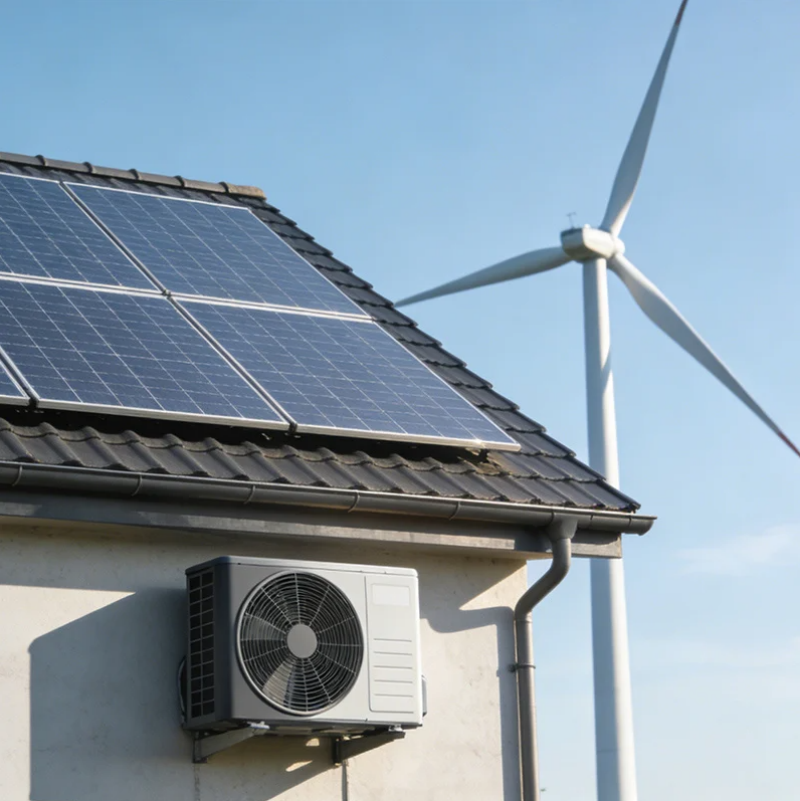
Across large office and warehouse spaces, ensuring temperature is kept at optimum levels and within the constraints of energy budgets and sustainability goals are a common but nagging issue for facility managers. The reliance on gas heating systems can no longer be a sustainable option, and many believe that simply opting for electricity will force them to sacrifice power and money. This is not the case, however; as commercial heat pump systems in real life are already a proven fact.
Why Commercial Heat Pumps Are Gaining Traction in Large Buildings
Heat pump technology has come a long way. New generation commercial installations will cope with such giants as 50 m x 50 m warehouse rooms 8 metres high, or logistics centres, and manufacturing plants. This is an economically interesting case too.
Costs of operation can be lower than gas by between 20% and 30%.
Furthermore, the carbon emissions reduction is going to be by dozens of percent.
Take a 62,500 m² warehouse in Poland: gas was completely removed, replaced by a solution of heat pumps that generate heat and cooling from air. Heat pumps use an R32 refrigerant and achieve a GWP (Global Warming Potential) of 65 percent less than commonly used fluids . Benefits for facility owners: reduction of operational costs and real advances on the path of environmental sustainability.
Design Considerations for Warehouse Applications
However a heat pump commercial setup that is planned out and designed for commercial usage would need a proper system design. One of the biggest issues found in a warehouse is heat stratification where the warm air gets to the ceiling but you are still feeling the chill at the ground. State-of-the-art systems that use intelligent air-distribution technologies are developed with strategies to avoid the occurrence of this problem.
Certain designs will even feature destratification fans to recycle the trapped heat to working levels in an attempt to use less energy and create a better temperature environment for the users . This is especially useful when used with designs of a larger height, allowing a constant temperature to be achieved without the high costs.
When embarking on any project you will most benefit by simply reducing the heat required in the first place by adding insulation to reduce losses through walls and floors and sealing air leakage paths into and out of the building .
Hybrid Systems: A Practical Step Toward Full Electrification
Not all buildings are in a position to convert completely to all electric. A hybrid system - a combination of heat pumps with a condensing gas boiler can be a good way to phase over. The primary source of heat comes from the heat pump and this provides most of the heating for a building with the boiler supplementing heat at very high usage, in cold weather when ambient temps go down to about 4 °C and lower.
This approach has been successfully installed at Stansfield Business Centre in Sunderland, which features a 32kW air source monobloc heat pump and a condensing gas boiler managed through a Building Management System.
The advantage is there for all to see – a building that can decarbonize without compromise of performance, even being in a position to remove the boiler entirely as the system is refined.
Real-World Performance and Return on Investment
Commercial heat pumps have approve performance through installations. One installation at an Oxford warehouse has fitted an air to air heat pump system that has reached COPs of 4.36, and can offer heating and cooling (and also integrate with solar panel and battery storage).
A Belgium-based 120,000 m² logistics centre is using a single central R290 heat pump installation instead of its existing gas heating solutions. Using R290 (propane) with an associated Global Warming Potential of only 3 (compared to 675 for R32) greatly reduces climate impact and CO₂ emissions compared to gas for heating. It also offers scope for eventual integration with renewable electricity and battery storage.
A 715kW heat pump installation has been installed at a 25,000m2 warehouse in Poland to replace gas which produced an estimated 186 tonnes of CO₂a year. It has the benefit of both heating and cooling from a single install and is all controlled centrally and output modified according to work demand.
Conclusion
Commercial heat pump systems are becoming a viable option for warehouse and other large-building projects. When considering ease of installation, cost-effectiveness, lower utility bills and lower carbon emissions for those who are considering retrofitting a facility, there is no easier alternative than this type of alternative system. For those that wish for a middle ground, a hybrid solution may suffice for now, while for those considering fully electric systems for future reference.
2009 year since that the enterprise is engaged in the decision in sphere renewable energy; products offered commercial pumps, PVT solar panel, wind turbines and LiFePO₄ batteries which can be incorporated in one energy system. Relying on quality and customer focus, DHC helps to solve tasks in low-carbon building functioning. Visit us and you will find out all commercial heat pumps to your decision.